
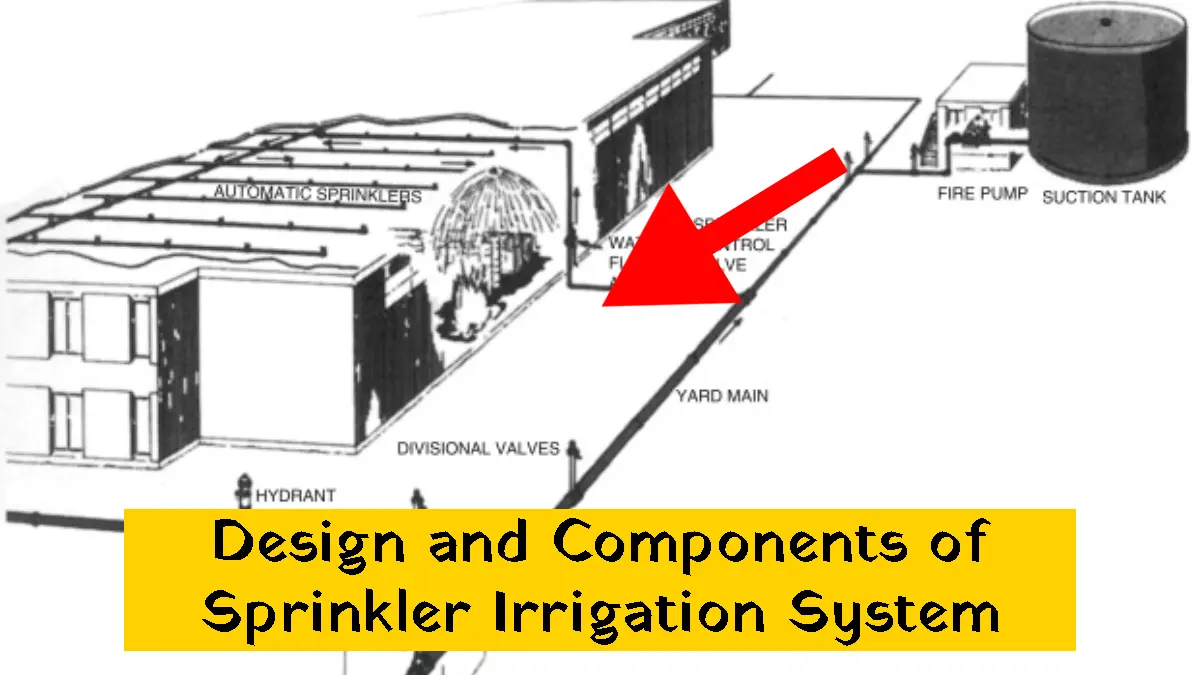
The selection of emitters is based on the soil and the root system of the crop. A pressure gauge is used to measure the expected variation in the water discharge of the emitters. The design of a sprinkler irrigation system involves measuring the land and making a sketch on graph paper. You should mark the location of fences, bushes, trees, walls, and paths on the sketch. Divide the area into blocks to lay the main lines and laterals. The next step is to determine the available water flow for the sprinkler system to find out how many sprinkler nozzles can run at one time. Plan the pipe layout according to the placement of risers and sprinkler nozzles.
What is a Sprinkler Irrigation System?
A sprinkler irrigation system includes a pump unit, main line, laterals, risers, and sprinkler nozzles, along with filters, desilting equipment, flow regulators, and a fertilizer application system. It is mostly used to moisten the environment, especially for young plants, sandy loam soil, greenhouses, or poly-houses, and sloping lands. In this system, water is delivered through pipes under pressure to the area to be irrigated, where it is released through sprinklers.
Main Components of the System
- Pump Unit: A pump is used to develop the necessary pressure. It is recommended for lands where leveling is difficult or costly, or where the water flow rate is very low.
- Filtration: A filtration unit is required to remove impurities from the irrigation water. The selection of a filter depends on the water quality. If the water quality is poor, a filter with a higher mesh size is used.
- Pipeline: The map of main, sub-main, and lateral lines depends on local conditions like topography and soil characteristics. In portable systems, laterals should be of the same size so they can be easily replaced.
- Sprinklers: Sprinklers are selected based on their nozzle size and operating pressure. It must be ensured that the water does not have a bad effect on the plants. It should also be suitable for the wind conditions in the area.
Common Sprinkler Symbols and Patterns
While designing, different symbols are used to represent different types of nozzles:
- Full Sprinkler: This nozzle throws water in a 360° circle, usually at a distance of 3.6–4.5 meters.
- Half Sprinkler: This nozzle covers 180° around its position.
- Two-Third Sprinkler: This nozzle throws water at 240° around it, covering 3.6–4.5 meters.
- Variable Arc Nozzle (VAN): This is a pop-up nozzle that can be adjusted from 0 to 360 degrees as needed.
Units of Measurement in Micro Irrigation
Measurement is useful for reducing standard errors. In the International System of Units (SI), there are seven fundamental units. All other units are called ‘derived units’ because they are created by multiplying or dividing the base units. For example:
- PSI: Pounds per Square Inch (used for pressure).
- KPa: Kilopascal (another unit for pressure).
Frequently Asked Questions (FAQs)
What is the first step in designing a sprinkler system?
The first step is to measure the land and make a sketch on graph paper, marking all trees, walls, and paths.
When is a pump recommended for irrigation?
A pump is needed when the land is not level, the soil is poor, or when the natural water flow is too low to reach all plants.
How do I choose the right filter?
Filter choice depends on water quality. If the water has a lot of dirt or algae, you need a filter with a higher mesh size to clean it properly.
What is a Variable Arc Nozzle (VAN)?
It is a special sprinkler nozzle that you can adjust. You can set it to spray water in any angle from 0 to 360 degrees.
How far can a standard sprinkler nozzle throw water?
Most standard nozzles mentioned in the design throw water at a distance of about 3.6 to 4.5 meters.
What is the difference between a main line and a lateral?
The main line carries water from the source to the field, while laterals are smaller pipes that carry water directly to the sprinklers.
Why are symbols used in irrigation maps?
Symbols are used to easily show the location of pumps, pipes, and different types of sprinkler heads on a paper map.
What does PSI stand for?
PSI stands for Pounds per Square Inch. It is a unit used to measure the pressure of the water inside the irrigation system.